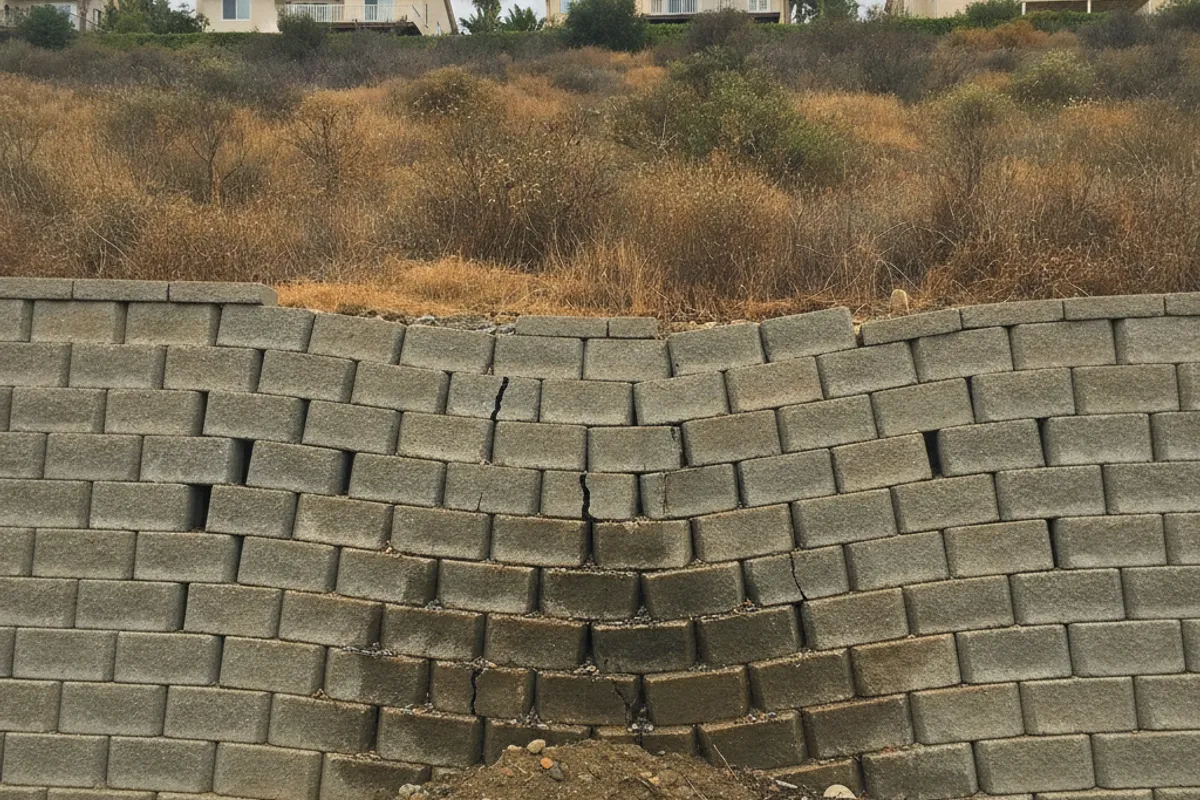
Five signs worth an inspection, not a guess: the wall leans or bows, cracks open or grow after rain, the wall pulls away from stairs or a driveway, soil or gravel piles at the base, or water stains and mineral deposits show on the face. If you see one of those, get a retaining wall inspection, not a general home inspection. Call (858) 400-4639 and we match you with a licensed local crew.
Visible distress is a reason to inspect
A retaining wall can show distress in the face, joints, and soil around it before it loses the lot it holds. Those signs do not prove how much time you have. Photograph what you see and get a licensed local crew to read the wall, not a timeline from this page.
Saturated soil behind a wall adds hydrostatic pressure. A wall that already leans or cracks can worsen after heavy rain. If you already see distress, get it assessed before the next storm, not after.
Leaning or outward bowing
The most obvious sign of wall distress is a wall that is no longer vertical or that has developed a visible bow outward from the slope. On a block wall, you may see this as a gradual curve across the face of the wall. On a poured concrete wall, it may appear as a tilt in the upper portion.
A wall leans because the lateral force pressing against it has exceeded what it can resist. That can happen because the wall was originally undersized for the retained height, because drainage was inadequate and hydrostatic pressure built up over time, because soil conditions were worse than anticipated, or because the soil above the wall has been loaded with additional weight such as a new structure, a driveway, or accumulated fill.
A lean is movement, not a cosmetic tilt. Get it assessed before it progresses.
Cracking in the wall face
Cracks in retaining walls are common, but not all cracks mean the same thing.
Vertical cracks that run from top to bottom of a concrete or block wall often indicate differential settling. The wall is settling at different rates across its length, which stresses the middle. Vertical cracks are worth watching but are not always a sign of imminent failure.
Horizontal cracks on a concrete wall, or horizontal displacement of a block wall where a course has pushed out relative to the one above or below, are more serious. Horizontal cracking indicates bending, where the wall is flexing under load. Have that read on site.
Stair-step cracking following mortar joints on a mortared block or brick wall indicates the wall is racking under lateral load. The mortar joints are the weak point and they crack in a diagonal pattern as the wall deforms.
Any crack that is widening over time, particularly after rain, is a warning sign. Photograph cracks and compare photos over several weeks to see if they are growing.
Separation between the wall and adjacent structures
If the retaining wall meets a house foundation, driveway, patio, or stairs, watch the joint between them. Separation at that joint means the wall has moved relative to the structure. Measurable movement at that joint is a reason to inspect, not a paint issue.
Gaps at stairs or a tilted run of steps relative to the wall are the same kind of signal. Photograph them and have the wall checked with the adjacent structure.
Bulging or erosion at the wall base
At the base of the wall, look for soil that has mounded outward from the wall face, or gravel and drain material that appears to be pushing through the wall. That can mean the wall is being pushed at the bottom, or that water is carrying material with it. Either one belongs in the inspection, not a label from this page.
Also look for erosion channels at the base of the wall. Water flowing out from under a wall is carrying material with it, which can undermine the base and reduce the wall’s stability over time.
Water staining and efflorescence
Heavy white mineral deposits on the face of a concrete or block wall indicate water is moving through the wall material. This is called efflorescence and forms when water dissolves minerals in the concrete and deposits them on the surface as it evaporates.
Efflorescence is not a structural emergency by itself, but it signals that water is getting behind the wall and finding its way through rather than draining out properly. Heavy or widespread efflorescence on an older wall often means the drainage system is not functioning correctly.
What to do if you see these signs
If your retaining wall shows one or more of these signs, a site visit from an experienced contractor is the right first step. They can assess whether the problem is cosmetic, whether it can be addressed with targeted repairs, or whether the wall has progressed to a point where replacement is the correct answer.
On a leaning wall or a wall with horizontal cracking, do not wait for another round of heavy rain. Saturated soil can add load quickly.
Document what you see with photos. Note whether the distress appears to be getting worse over time, and whether you have had any significant grading, loading, or construction above the wall since it was built.
Wall Pro SD connects San Diego homeowners with licensed local contractors who can evaluate retaining wall distress and recommend the right course of action. Call (858) 400-4639 for a site assessment.
For a professional assessment, see our retaining wall inspection and emergency retaining wall repair service pages.