Concrete block retaining walls in San Diego County
Concrete block and CMU walls are the workhorse solution for hillside lots, driveway cuts, and yard terracing across San Diego County. We connect homeowners with licensed local crews that pour proper footings, lay block to a specified height, and backfill with drainage aggregate so the wall holds for decades. In the City of San Diego a wall over three feet from the top of the footing needs a permit and, in most cases, engineered drawings. Every other city in the county sets its own trigger and the unincorporated county applies a separate test, so confirm yours with your own building department. Your crew confirms which rule applies and handles the paperwork.
Also called: cinder block retaining wall, CMU retaining wall. Same work, different words.
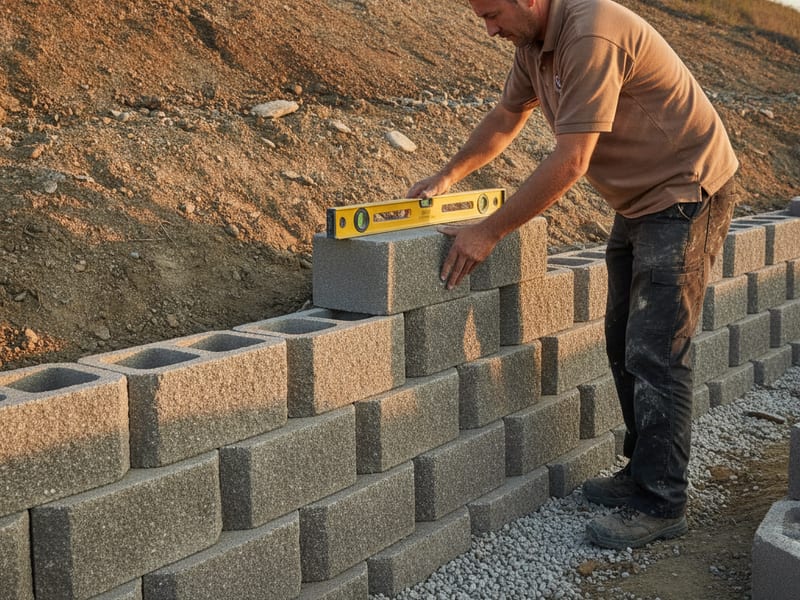
What's included in concrete block retaining walls?
- Excavate to undisturbed soil and pour reinforced concrete footings to grade
- Lay CMU or poured concrete block to specified height with vertical rebar and filled concrete cores
- Install open-graded drainage aggregate and perforated pipe behind the wall face
- Cap the wall and finish the exposed face with mortar wash or split-face texture
- Backfill and compact in lifts behind the finished wall to prevent settlement
- Pull permits and coordinate inspections when wall height or surcharge loads require them
When do you need concrete block retaining walls?
- A hillside lot needs a level pad, terrace, or driveway cut held back structurally
- The existing block or poured wall is crumbling, cracking through the face, or leaning away from the slope
- Erosion or slope creep is eating into the yard or threatening a structure
- A pool, addition, or garage pad requires a structural cut into a hillside
- The drainage behind an older wall has failed and hydrostatic pressure is pushing the face out
What do homeowners ask about concrete block retaining walls?
How much does a concrete block retaining wall cost in San Diego?
Most concrete block and CMU walls run a per-square-foot rate your crew quotes installed. That range covers footings, block, rebar, concrete fill, drainage aggregate, and backfill. Walls that need engineered plans, walls on steep or tight-access lots, and jobs with heavy drainage work push toward the top of that range or beyond. Your crew confirms the number after walking the site.
Do I need a permit for a concrete block retaining wall?
In the City of San Diego, yes once the wall is over three feet measured from the top of the footing to the highest point on the wall. A permit is also required at any height when the wall supports a surcharge load like a driveway, walkway, footing or fence, or retains a slope steeper than 1.5 horizontal to 1 vertical. Tiered walls count together: a permit is required once the height from the lowest tier top of footing to the top of the highest tier exceeds six feet, or when one tier footing crosses the slope stability plane of the tier below. Unincorporated county areas apply a different multi-condition test, and each other city sets its own rule, so confirm yours with your own building department. Your crew pulls the permit and handles plan-check submittal when the scope requires it. Ask any bidder which license classification covers the work as they propose to build it, then check that license yourself with the CSLB Check A License tool at cslb.ca.gov. CSLB publishes classification descriptions, not a rule assigning one classification to every retaining wall.
How long does a concrete block retaining wall last?
No one publishes a verified service life for San Diego walls, so treat any specific number you are quoted with caution. What decides it is construction, not the block: drainage that relieves hydrostatic pressure behind the face, and a footing bearing on undisturbed native soil rather than disturbed or expansive fill. Ask any crew to show you both details on the plan before you sign.
Can concrete block walls handle the expansive clay soils in East County?
Yes, with the right footing depth and drainage design. East County clay soils expand when wet and contract when dry, which cycles stress into wall footings. Crews in Santee, El Cajon, and Spring Valley typically deepen footings below the active zone, use wider base pads, and pay close attention to drainage aggregate depth so water exits before pressure builds.
My block wall is leaning. Does the whole thing have to come down?
Not necessarily. A wall that has leaned due to drainage backup behind it may stabilize after proper drainage is installed and the face is re-plumbed, if the footing and block courses are still intact. A wall that has lost its footing to undercutting erosion, cracked through at multiple courses, or moved enough to create a gap at the cap usually needs full replacement. The on-site inspection tells you which it is.
Where do we offer Concrete Block Retaining Walls in San Diego County?
We match concrete block retaining walls jobs in every city and community in San Diego County. Pick your city for local climate notes and service specifics.
See concrete block retaining walls in all 67 cities
Need concrete block retaining walls in San Diego County?
Call and we match you with licensed local wall crews.