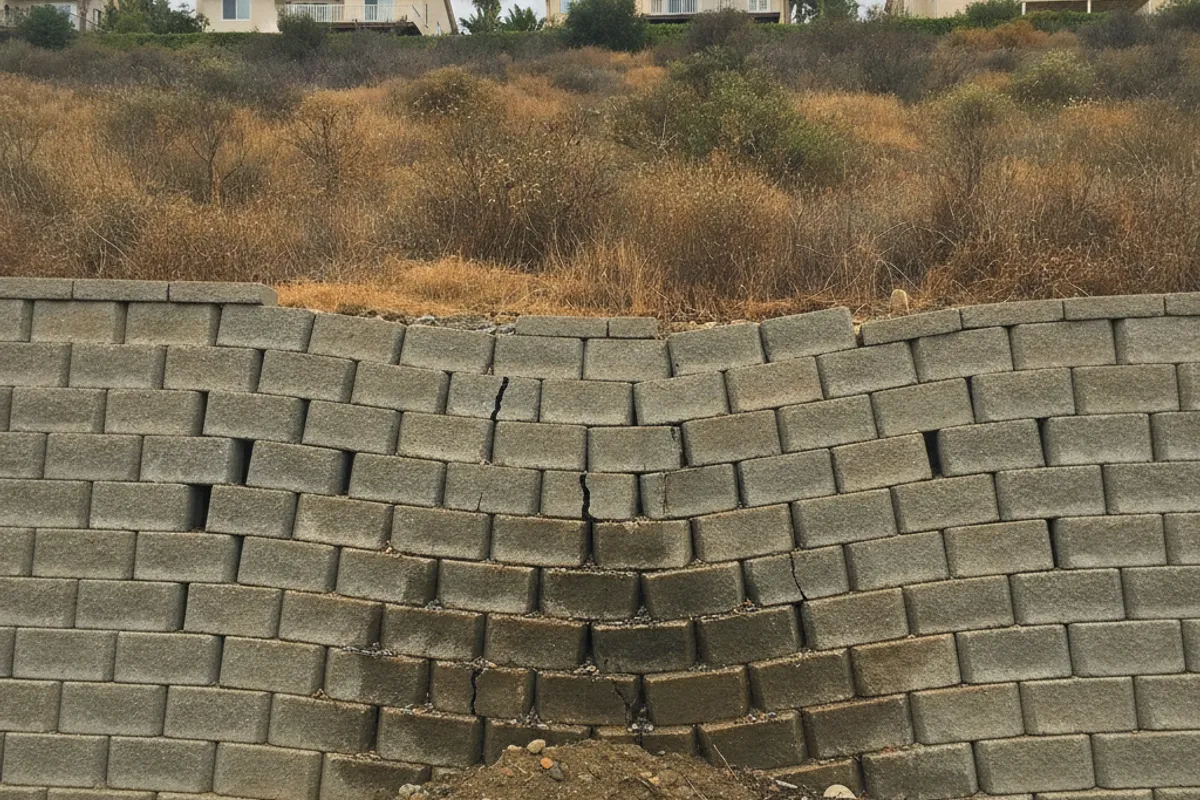
The short answer
Retaining wall repair vs. replacement comes down to how far the distress has spread. A wall often calls for repair, not replacement, when the damage is localized: one section is cracked or bulging, the footing underneath is still sound, and the cause can be fixed without tearing the whole structure out. Replacement is the right call when the lean or cracking runs along most of the wall, when a section has already been patched once and failed again, or when the wall was undersized for the load it is carrying. The deciding factor is almost never age. It’s whether the underlying cause has been dealt with or is still active.
That distinction matters because a repair-or-replace decision made on looks alone gets it wrong in both directions. Homeowners patch walls that needed to come out, and they tear out walls that only needed a section rebuilt and proper drainage added behind it. Getting the call right starts with understanding what’s actually happening below grade, not just what’s visible on the face.
How to tell if a retaining wall can be repaired
A repairable wall shares a few traits. The damage is contained to one section rather than spread across the full run of the wall. The footing hasn’t shifted, which you can usually confirm by checking whether the base of the wall is still level and hasn’t rotated forward. The material is still structurally sound where it isn’t damaged, meaning block units aren’t crumbling and poured concrete isn’t honeycombed or spalling throughout.
Cracking is the detail most homeowners get wrong. A single vertical crack from differential settling is often a repair. Horizontal cracking, or a course of block that has pushed out relative to the ones above and below it, usually means the wall is bending under load across its whole height, which is a replacement signal even if it looks like “just a crack” from the sidewalk.
Drainage failure without structural movement is the cleanest repair case. If a wall is staining heavily with efflorescence, or water is visibly exiting at the base without a proper drain outlet, but the wall itself is still plumb and hasn’t cracked, that’s often a drainage retrofit rather than a rebuild. Adding drain rock, a perforated pipe, and a proper daylight or dry-well outlet behind an otherwise sound wall can stop the water load that was driving the stain. It is not a published life-extension or cost-ratio.
When replacement is the right call
Replacement is the right call once the distress stops being local. A wall that’s leaning along its full length, not just at one spot, has already lost the structural margin that made it stable in the first place. Patching the visible crack doesn’t change the geometry that caused the lean.
It’s also the right call on any wall that’s been repaired once for the same problem and failed again. A second round of cracking or bowing in the same location means the first repair didn’t address the actual cause. Drainage left dead, or a wall that was never built to hold the load, are two common reasons a patch comes back. Rebuilding without correcting that cause just buys another cycle of the same failure.
Age matters less than most homeowners assume, but wall type does. Once a timber or railroad-tie wall starts rotting at the base, that is a material failure, not a patchable defect. Replacement with a longer-lived system is the usual path, not a like-for-like rebuild of rotten timber.
A wall over the City of San Diego permit trigger (over three feet from the top of the footing, plus the surcharge and slope cases in Information Bulletin 220) is a permit question, not an automatic teardown. Confirm height on a section drawing. If the wall was never permitted for that height, the honest next step is the permit path and whatever the plan requires, which may be repair, rebuild, or leave-it after assessment. It is not a rule that every unengineered wall over three feet must come out.
What actually drives the cost difference
We don’t publish flat per-foot price ranges on this site because a number that doesn’t match your lot is worse than no number. What’s true in general: a contained repair, meaning drain work plus rebuilding one damaged section, costs meaningfully less than a full teardown and rebuild, because you’re not removing and hauling the entire wall, re-excavating the full run, or re-engineering the whole structure.
That gap narrows fast once a “repair” turns into partial demolition. If a crew opens up a section and finds the footing has shifted, or finds the soil behind the wall saturated and unstable, the job can grow into something closer to a full rebuild mid-project. That’s the real argument for a proper site assessment before signing a repair-only scope: nobody wants a change order halfway through because the actual condition of the wall wasn’t visible until the crew started digging.
Replacement carries its own cost drivers beyond the wall itself. Demolition and haul-off of the old material is a line item. If the original wall wasn’t engineered and the new one needs to be, add the engineer’s fee and permit before the first block goes in. None of that means replacement is automatically the expensive path. A wall that keeps failing and getting re-patched every few years can cost more over a decade than a single correct rebuild.
Repair vs. replacement: what actually tips the decision
Trapped water behind a wall can add hydrostatic pressure. A repair that patches a crack and leaves the drainage dead often fails again. Before agreeing to a repair-only scope, confirm the plan includes checking drainage, not just the visible damage. See drainage.
Access can dominate cost on a tight or steep lot. That can narrow the gap between a contained repair and a rebuild. It is a site finding, not a neighborhood label.
If you already see cracking, leaning, or staining, get the wall assessed before the next heavy rain. Saturated soil can add load quickly. We do not publish a San Diego storm calendar as a design rule.
Getting the right assessment
The only reliable way to settle repair vs. replacement is a site visit from someone who can check the footing, confirm whether the movement is contained or has spread, and test whether drainage behind the wall is actually functioning. Photos from the sidewalk can’t tell you whether a wall has rotated at the base or whether the soil behind it is saturated.
Ask whoever assesses your wall to be specific about what they found and why they’re landing on repair vs. replacement, not just which one costs less to quote today. A contractor who can point to the actual cause, drainage, footing movement, undersized original construction, and explain how their recommendation addresses that cause is giving you a real answer. One who just quotes a number without explaining the cause is guessing along with you.
Wall Pro SD connects San Diego homeowners with licensed local retaining wall crews who can assess a distressed wall and give you a straight answer on repair versus replacement. Call (858) 400-4639 to get a site visit scheduled.
For more on catching problems early, see signs your retaining wall is failing and drainage behind retaining walls. For cost drivers on a full rebuild, see cost of a retaining wall in San Diego. Related service pages: emergency retaining wall repair, retaining wall inspection, and drainage solutions for retaining walls. Wall Pro SD also serves Spring Valley and the surrounding hillside communities.
Frequently asked questions
Can a leaning retaining wall be repaired without full replacement?
Sometimes, but only if the lean is contained to one section and the footing hasn’t rotated. A lean that runs the full length of the wall almost always means the whole structure has lost its margin, which points to replacement rather than a patch.
How much of a wall has to fail before it needs replacing instead of repair?
There’s no fixed percentage, but once distress covers more than a small section, or the wall has already been repaired once for the same problem and failed again, replacement is usually the more honest recommendation than a second patch.
Does a repaired retaining wall fail again if drainage isn’t fixed too?
Often, yes. Hydrostatic pressure from trapped water can crack or bow a repaired section again. A repair scope that skips drainage is treating the visible damage, not the load.
Is it cheaper to repair a retaining wall than to replace it?
A contained repair costs less than a full rebuild in most cases, because you’re not removing and re-excavating the entire wall. That gap can close fast if a repair opens into partial demolition, or if a wall needs repeated repairs over several years instead of one correct rebuild.
Do timber retaining walls get repaired or replaced when they fail?
Once a timber or railroad-tie wall starts rotting at the base, that’s a material failure rather than a repairable defect. Replacement, usually with block or poured concrete, is the typical recommendation rather than patching a wall built from a material that’s already at the end of its working life.
When should I get a retaining wall assessed before deciding on repair or replacement?
If you already see cracking, leaning, or staining, get it assessed now. Do not wait for the next heavy rain to make the decision.