The first real rain of the season is when a quiet San Diego hillside wall stops being quiet. A dry summer, then a storm, and a block face that sat plumb in August is leaning over a patio in Mission Hills or spilling soil onto a driveway in El Cajon.
What counts as an emergency versus a wall that can wait
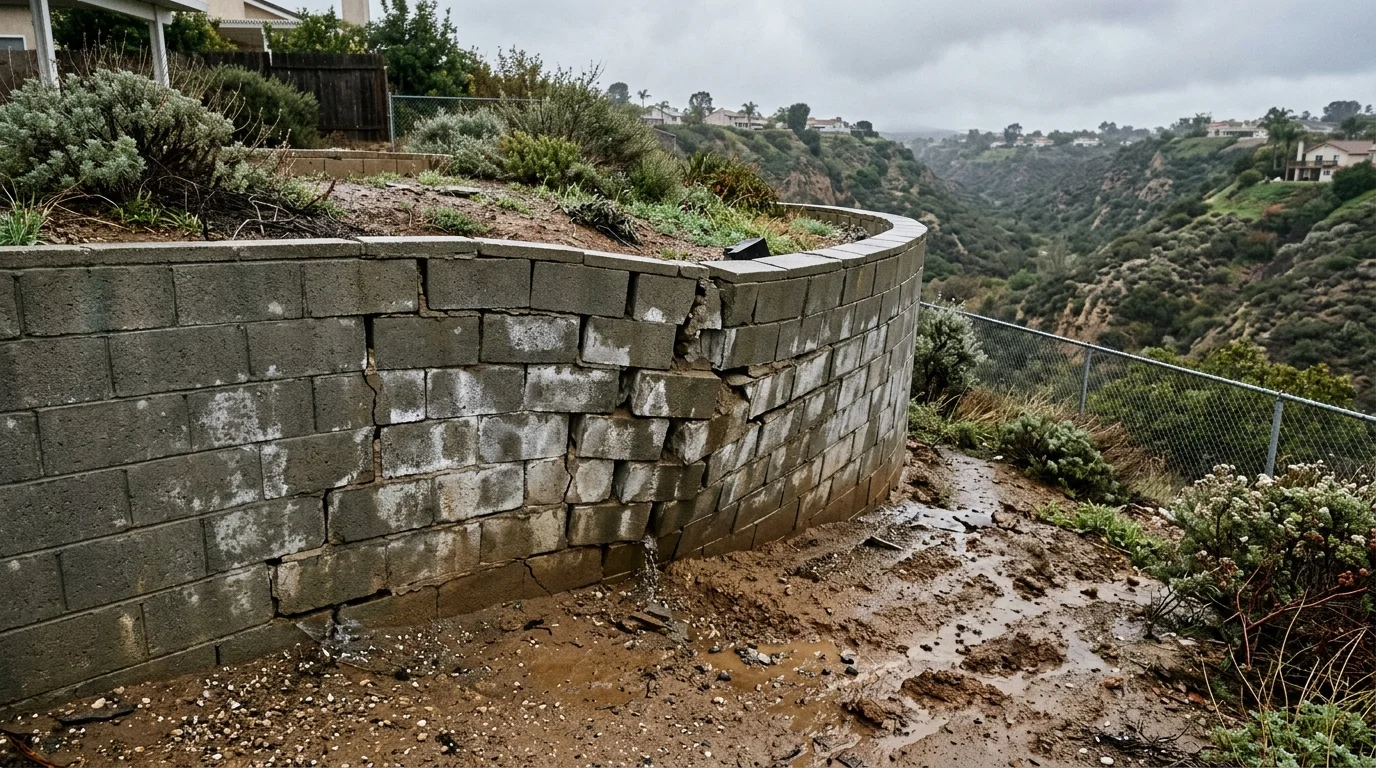
An emergency is a wall that’s moving now, or that could take a person, a car, or a house with it if it keeps going. Hairline cracks that have looked the same for two summers are a watch item. A bulge you can see from the alley isn’t.
Treat it as emergency retaining wall repair in San Diego when the wall is leaning, bowing, or rotating; a section has dropped or opened at a joint; soil or water is coming through the face; the wall holds a driveway, walk, or house pad; a crack that was closed last week now shows daylight; or the grade behind it has sunk.
Those last points matter because of how the City of San Diego treats load. Inside city limits, Information Bulletin 220 (October 2024) says a retaining wall needs a building permit when it supports surcharge loads. Surcharge includes driveways, walkways, structure footings, and fences. A 2-foot wall with a car on it is still a loaded wall.
A wall that can wait is plumb, dry, and quiet. Staining at a weep hole or a crack that hasn’t grown is inspection territory. Get a retaining wall inspection on the calendar before the next storm, not after the soil is already moving. Don’t patch a leaning wall with extra block, extra dirt, or a new fence on top. That adds weight. It doesn’t add strength.
People ask who is “responsible” for a failing wall. That’s a neighbor-and-lawyer question. City rules do say wall drainage can’t discharge onto adjoining properties, and the wall has to stay on the applicant’s lot. Civil Code section 832 covers notice and support when someone excavates near a property line. It isn’t a runoff rule, and it isn’t a verdict about who pays.
Leaning, cracking, and soil moving after the first real rain
San Diego’s pattern is long dry stretches, then a first storm that hits hard. Soil behind a wall can sit thirsty for months while lawn irrigation and hillside drip lines keep feeding it. Then one October or November rain saturates the backfill. The wall feels that as a shove, not a drizzle.
That’s why a leaning retaining wall in San Diego often “appears” overnight. The rain didn’t invent the lean. It finished a job that dry months and irrigation had already started.
Canyon-rim lots take this worse than a flat Clairemont pad. A wall in Tierrasanta, Kensington, or along a Mission Valley cut is holding a slope, not a planter. East County cuts around El Cajon and Mount Helix take the same shove after hotter summers. Chula Vista and National City sit in a different city, with a different building department. Unincorporated Lakeside and Alpine follow County PDS rules, not the City bulletin.
A clogged weep hole is a common tell after that first rain. Staining and wet soil at the toe mean water isn’t leaving through the weeps. For City standard cantilevered masonry designs, Information Bulletin 221 calls for a 4-inch perforated drain with a filter-fabric sock to a stormwater system, and a 12-inch gravel layer behind the wall. Those specs apply only to those standard City designs, up to 6 feet, on non-expansive soil, with no surcharge and none of the listed geologic hazards. The City’s standard designs may not be used to retain expansive soils.
Stop irrigation and downspouts that dump behind the wall, then have a licensed pro look at the face, the weeps, and the grade. A retaining wall collapse after rain is rarely a mystery. Water sat where it should have left. The repair has to fix that path, not just restack the block, which is why drainage failures show up after the first storm.
What a licensed pro checks before anyone starts tearing out block
The first visit isn’t a demolition. The licensed contractor checks plumb and bulge, weeps and staining, what sits above the wall, the property line, and whether you’re in the City, the unincorporated county, or another city.
Inside city limits, building-permit height is top of footing to the highest point on the wall. Zoning height is finished grade on the lower side to the top. Those two numbers aren’t the same. Information Bulletin 220 (October 2024) requires a building permit when any of these is true: the wall is over three feet by the footing-to-top measure; it supports a sloping backfill steeper than 1.5 horizontal to 1 vertical; it supports surcharge; it impounds flammable liquids; or it’s a tiered wall over six feet from the bottom-tier top-of-footing to the top of the top-tier wall, or a footing that crosses a lower wall’s 2:1 slope stability plane.
The unincorporated County rule is different. County PDS 110 (Rev. 01/01/2026) exempts a wall only when all of this is true at once: not over three feet of retained soil from top of footing to top of retained soil, not more than 6 feet total height from lowest finished grade, level backfill, no other structures within 6 feet, and no surcharge or flammable liquids. Chula Vista, Oceanside, Escondido, Carlsbad, El Cajon, Poway, and the other incorporated cities set their own rules. Those cities’ current triggers could not be confirmed. Call that city’s building department before anyone treats a repair as exempt.
The City’s Seismic Safety Study maps are a guide and don’t furnish site-specific information. A geotechnical report is required for all proposed development in several hazard categories, including slope instability 21, 22, 24, and 26, liquefaction 31 and 32, coastal bluffs 41 through 47, and coastal beach 48.
People search a “one-third rule” for how much wall should sit below grade. That phrase could not be confirmed as a City or County building rule. Use Information Bulletin 221 for standard designs inside city limits, or a California-licensed civil or structural engineer or architect when the wall doesn’t fit those designs.
Shoring, drainage, and when a section has to come down
Yes, a retaining wall can be repaired. Sometimes a section has to come down. Sometimes it can stay if the drainage is rebuilt and the face is still sound. That’s the repair versus replacement call, and it belongs to the licensed pro on site.
Shoring is temporary. It holds soil and the remaining wall while the failed bay is opened. The contractor we connect you with handles that work. Wall Pro SD doesn’t shore, excavate, or rebuild.
Drainage is usually the permanent half of failing retaining wall repair. If the outlet is buried or irrigation is still soaking the backfill, a new face will lean again. For City standard designs, wall drainage has to run the length of the wall and can’t discharge onto a neighbor.
A section comes down when the bulge is through the face, the footing has rotated, the units have split, or the wall was never built for the load it’s carrying. A driveway or second wall added later can turn a garden wall into a surcharge wall. Inside city limits, two walls in a required side or rear yard may each be 6 feet if they’re separated by a distance at least equal to the height of the upper wall (SDMC section 142.0340).
If a walking surface sits on the high side and the drop to low-side finished grade is greater than 30 inches, the City’s standard-design bulletin calls for 42-inch open guards. That trigger is the drop, not the wall’s named height.
Don’t start tearing out block because a video said to. Civil Code section 832 requires reasonable notice before excavating near a property line, and at least 30 days if an adjoining building owner wants to protect their structure. Permit fees live in Information Bulletin 501. Those amounts could not be confirmed. Rapid Review is available under Bulletin 220. That bulletin doesn’t publish a timeline.
How matching works: the local pro does the work
Wall Pro SD is a referral service. We match you with a licensed, independent retaining wall contractor in San Diego County. We don’t hold the trade license, we don’t own the trucks, and we don’t pour the footing. The pros we send do the licensed work.
You want the person on your slope to be the person whose license you can look up. Search CSLB Check A License by license number or business name before you sign. California requires a contractor license unless the job is under $1,000 in aggregate and no building permit is required (Business and Professions Code section 7048, as amended effective January 1, 2026). A wall that trips a City permit trigger can’t use that exemption at any price. Unless exempted, acting as a contractor without a license is a misdemeanor under section 7028. On a home improvement contract, a down payment can’t exceed $1,000 or 10 percent of the contract amount, whichever is less. On a $30,000 wall, that cap is $1,000, not $3,000.
You call. You describe the wall: city or unincorporated, height as best you can tell, what it holds, and what moved after the rain. We connect you with a local pro who does this work. They tell you if the wall can be repaired or has to come down. They handle shoring, drainage, and rebuild if that’s the job. Warranties, if any, come from that contractor, not from Wall Pro SD.
If you’re still deciding whether it’s failing, start with the signs a retaining wall is failing and book an inspection. If a bay already has to go, use emergency retaining wall repair. Other cities in the county aren’t the City of San Diego. Confirm permits with that city’s building department, or with County Planning & Development Services if you’re unincorporated.
When to call us
Call when the wall is leaning, bulging, or pushing soil after rain, or when it holds a driveway, walk, or the edge of a pad and you can see it move. A licensed retaining wall contractor has to inspect, shore if needed, and rebuild or redrain the failed section. Call us at (858) 400-4639 and we’ll connect you with a licensed local retaining wall contractor.