If you’re researching boulder retaining wall cost, there isn’t a verified public San Diego price per foot. Government sources don’t publish current boulder, delivery, equipment, or labor rates. The reliable answer comes from written quotes based on your wall, access, drainage, and permit needs.
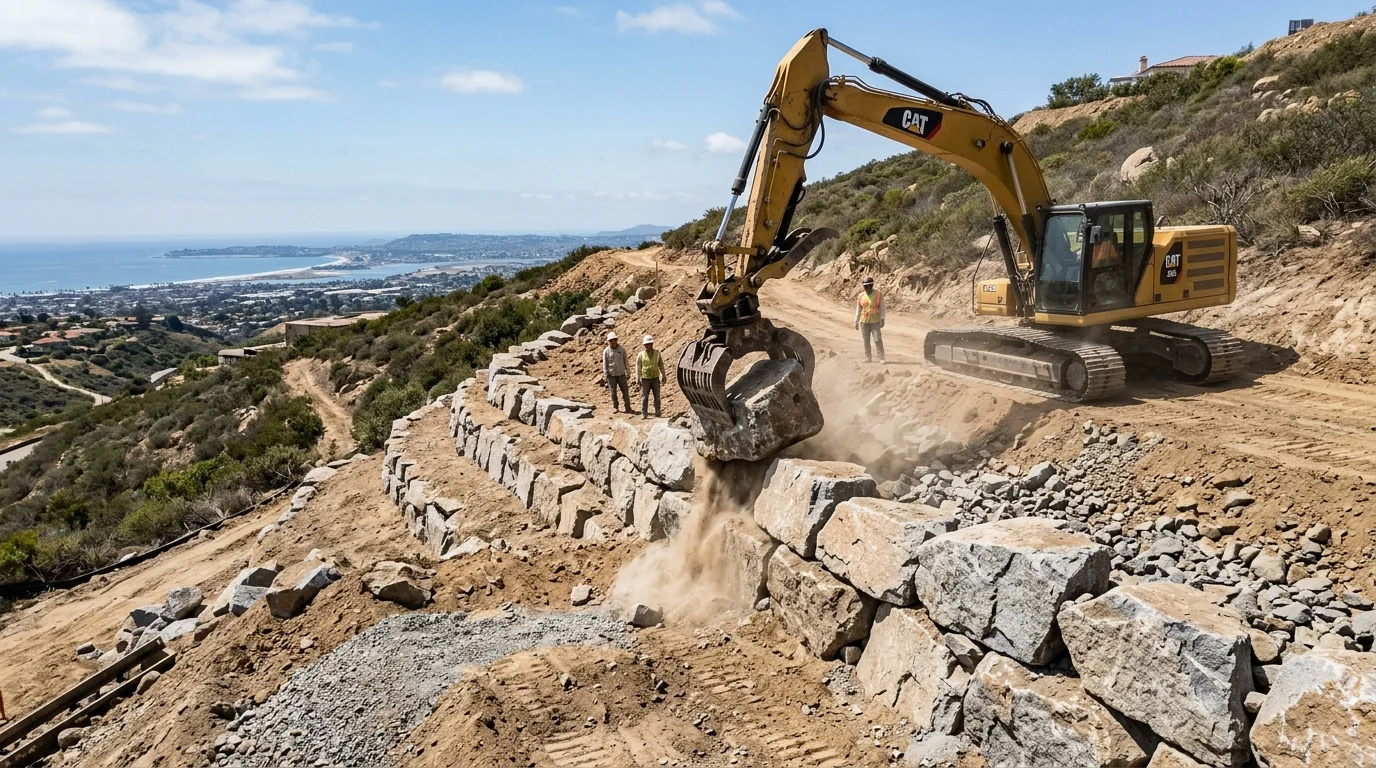
Compare the rock price with the full project quote
No verified public source confirms which item is usually the largest expense. A pile of boulders isn’t a completed retaining wall, and a material-only price doesn’t reveal the project total.
Ask each contractor to separate these parts of the proposed work:
- Boulder material, including the specified type and quantity
- Delivery, unloading, staging, and placement
- Excavation and removal of displaced soil
- Equipment and operator time
- Drainage, backfill, and erosion-control work
- Engineering, plans, and permit tasks when required
- Restoration of disturbed landscaping or hardscape
This breakdown shows whether two estimates cover the same project. One bidder might include excavation and drainage. Another might show only rock placement. The totals can’t be compared until those differences are clear.
The contractor should also define what “complete” means. Ask where the wall begins and ends. Confirm its planned height from both sides. Identify steps, corners, terraces, and transitions into the existing slope. Written dimensions help prevent a low quote from hiding a smaller scope.
Current San Diego boulder rates couldn’t be confirmed through CSLB, City, County, or federal sources. The contractor and material supplier set those amounts. Ask how long the quote remains valid and whether delivery is included. If the material price changes, the contract should explain how that change will be handled.
For a closer look at the material itself, see our guide to natural stone retaining walls.
Access decides the machine, and the machine decides the price
There isn’t a verified government formula for an access surcharge. The practical way to measure access cost is simple. Have each bidder inspect the same route and price the same placement plan.
Start at the street, not the wall. Measure gates and side yards. Note driveway turns, steps, fences, overhead lines, roof edges, trees, and neighboring structures. Show the contractor where material could be staged without assuming public space is available.
Then ask which machine the quote includes. The written scope should identify how boulders will travel from the delivery point to the wall line. It should also explain whether fences, gates, planting, or paving must be removed. If restoration isn’t included, request a separate line item.
A hillside site needs another layer of detail. Ask where equipment will stand during excavation and placement. Confirm whether the proposed work stays within your parcel. City of San Diego guidance says retaining-wall elements, including footings and drainage, must remain on the applicant’s property. Its standard wall guidance doesn’t allow encroachment onto neighboring property.
Street conditions also deserve attention. A narrow residential street, sloping driveway, or limited staging area can change the contractor’s proposed method. Don’t guess at that effect. Ask bidders to describe it and price it in writing.
Photographs help with initial conversations, but they don’t replace a site review. Include the street approach, access path, upper slope, lower grade, and both ends of the proposed wall. Contractors can then flag missing measurements before preparing a final quote.
Boulder size, sorting and where San Diego rock comes from
No verified public source identifies a standard boulder size, a typical San Diego quarry, or a current local rock price. Those details must come from the contractor and supplier handling your project.
Ask for a material description that’s more specific than “landscape boulders.” The quote can name the supplier, stone type, planned size range, finish, and sorting standard. Request photos or a sample when appearance matters. Natural stone varies, so the contract should explain how the selected material will be approved.
Material and delivery should appear separately. That makes it easier to compare a quote using local inventory with one involving another source. Ask whether the delivery line covers unloading only or placement at the wall. Those are different tasks, and the written scope should show the boundary.
Sorting also affects what you receive. Ask whether the contractor is selecting individual stones or accepting a mixed load. Confirm how small pieces and visible gaps will be handled. If the wall has a finished face, identify which side must present the intended appearance.
Don’t accept a claimed stone origin without documentation. A supplier quote, load ticket, or product description can confirm the source. If the origin can’t be verified, the contract can simply identify the material by an agreed visual and physical description.
Color samples should be viewed at the property when possible. San Diego’s strong daylight can make a stone look different from a shaded yard display. That observation doesn’t establish quality, but it can prevent an avoidable appearance mismatch.
Height limits and where boulders stop being enough
There isn’t one verified height where boulders automatically become unsuitable. Wall height, retained soil, backfill, surcharge, drainage, property lines, and mapped hazards all affect the design review. Local jurisdiction matters too.
Inside City of San Diego limits, Information Bulletin 220 says a building permit is required when any listed trigger exists. One trigger is a wall over three feet, measured from the top of the footing to its highest point. Others include surcharge loads and backfill steeper than 1.5 horizontal to 1 vertical.
A driveway, walkway, structure footing, or fence can count as a surcharge. That means a shorter wall may still require a permit. Tiered walls also have separate triggers. These include a combined measurement over six feet or a footing crossing the lower wall’s specified slope-stability plane.
The City’s standard wall designs don’t settle the boulder question. Information Bulletin 221 covers masonry walls within its stated limits. It also excludes surcharge loads, expansive soils, and listed geologic hazards. Work outside those criteria must be designed by a California-licensed civil engineer, structural engineer, or architect under the bulletin.
City hazard maps may help determine whether a geotechnical report is required. However, the City says those maps are guides and don’t provide site-specific information. Don’t use a neighborhood name to decide your parcel’s conditions.
Unincorporated San Diego County follows a different verified exemption. It requires every listed condition, including limits on retained soil and total height, level backfill, no nearby structure within six feet, and no surcharge. Incorporated cities outside San Diego set their own rules, which weren’t confirmed in the approved research. Check with that city’s building department.
When the work involves a broader hillside problem, review slope stabilization options with the licensed professional evaluating the site.
Comparing a boulder quote against a block quote
Compare equal designs, not equal lengths. A boulder concept and a block concept may describe different heights, footprints, drainage plans, excavation limits, or finish work. Ask each bidder to mark those items on a plan or detailed sketch.
Use the same checklist for both proposals:
- What soil height will the wall retain?
- How is wall height measured on each side?
- What load sits above the wall?
- Where do drainage pipes discharge?
- What excavation and disposal are included?
- Who prepares plans and submits permit documents?
- What site restoration is included?
- Which contract changes require written approval?
Then compare exclusions. A lower total may leave engineering, permits, drainage outlets, soil removal, or landscape restoration to the homeowner. That doesn’t make the quote wrong. It means the remaining responsibilities must be identified before signing.
Material choice also changes the finished character. Boulder walls use natural stone shapes and visible joints. Block systems follow manufactured units and a planned course pattern. Our block, concrete, and boulder wall comparison explains those distinctions without assigning an unsupported lifespan or market price.
Verify the proposed contractor through the CSLB Check A License tool. CSLB’s C-29 classification description includes natural stone and structural load-bearing walls. However, CSLB doesn’t publish a rule saying every retaining wall requires C-29. The proper classification depends on the actual work.
For California home improvement contracts, the verified down payment rule is also useful. Business and Professions Code section 7159.5 limits a down payment to $1,000 or 10 percent of the contract amount, whichever is less. Later payments can’t exceed the value of completed work or delivered materials.
When to call us
A licensed retaining wall pro should review boulder work involving slopes, surcharge loads, drainage, uncertain property lines, or possible permit triggers. Call us at (858) 400-4639 and we’ll connect you with a licensed local retaining wall contractor.