The first real storm after a wall goes in is when you find out if anyone left a path for the water. A french drain behind a retaining wall is that path: a perforated pipe in gravel that collects water at the heel and takes it to a legal outlet. It is not a product you pour in after the dirt is already back.
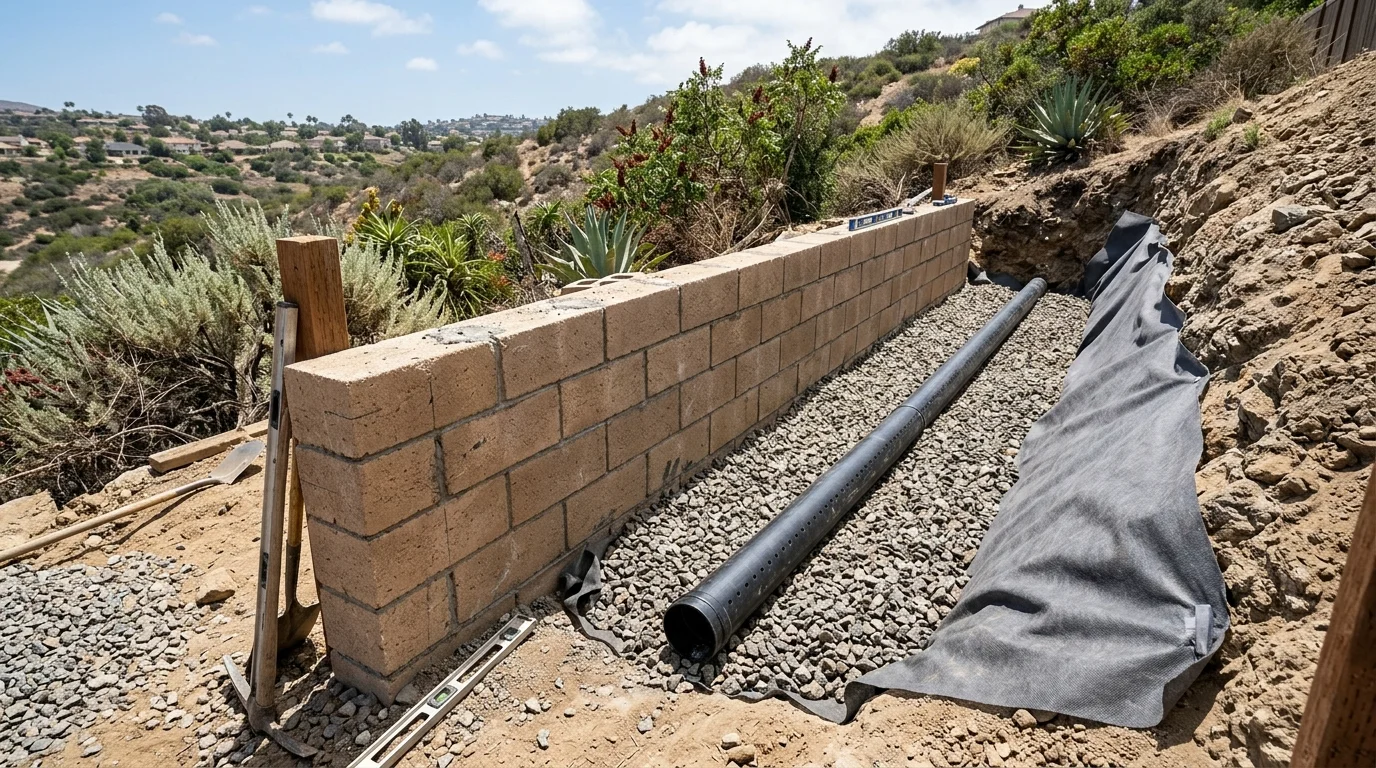
A french drain is an outlet path, not a product you pour in later
Water from the pad, the slope, and the planter has to leave. If it has no path, it sits against the wall. A french drain is the path. Pipe, gravel, and fabric work as one run, from the footing to a discharge the lot is allowed to use.
Once backfill is in, the drain is either there or it is not. You cannot add a real one from the face of a finished wall. Retrofit means digging the retained soil back out, placing a new run, and proving the outlet. That is wall work again, not a weekend trench along the grass.
San Diego makes that timing less forgiving than a long, wet midwest yard. Rain here comes in short, hard stretches, then stops. A Mira Mesa or Carmel Valley pad can hold water on the high side of a wall for days. A canyon-rim lot in Mount Helix, Spring Valley, or Alpine sheds it downslope fast. A Chula Vista or National City side yard may have only a few feet to the fence. Encinitas and El Cajon are not the same problem with the city name swapped. The outlet has to match the lot you actually own.
Inside City of San Diego limits, the City’s standard cantilevered masonry designs (up to 6 feet, with the bulletin’s limits on slope, surcharge, soil, and geologic hazards) require wall drainage along the length of the wall. Information Bulletin 221 says the pipe discharges or connects to a stormwater collection system. Wall drainage discharging onto adjoining properties is prohibited. That is a City permit rule, not a statewide private-drainage law.
Other incorporated cities publish their own rules. A matching french-drain spec for Chula Vista, Oceanside, Escondido, Carlsbad, El Cajon, or Poway could not be confirmed from the same kind of city bulletin. Those building departments set what a lot inside their limits needs. Unincorporated parcels follow County of San Diego Planning & Development Services, not the City bulletins.
If you want the physics of trapped water against a wall, that lives in why retaining wall drainage fails. This is the named assembly: the retaining wall drain pipe, the gravel, and the fabric, and where that run is allowed to go.
Pipe, gravel, and fabric: the three parts that have to work together
Skip any of the three and water still has nowhere useful to go.
Pipe first. For the City of San Diego’s standard masonry designs, the bulletin calls for a perforated drain pipe with a minimum diameter of 4 inches, protected with a filter fabric sock. That is the City’s standard-design spec, not a universal California size. An engineered wall, a segmental block wall, or a wall outside city limits may call for a different pipe. The contractor you are matched with should draw the pipe that belongs to that design, not a generic coil from a weekend display.
The perforations collect water. The run carries it. A pipe with no fall to an outlet is a buried trough. The City’s language is “along the length of the wall,” at the drainage level the design shows, not a short stub under one end.
Gravel next. The same City standard design calls for a 12-inch-wide layer of gravel placed directly behind the retaining wall. That layer runs from the top of the footing to a height 12 inches below finished grade on the upper side. The rest of the backfill, for those designs, is sandy or gravelly soil in the Unified Soil Classifications GW, GP, SW, or SP, as the bulletin points to in the California Building Code table it cites. Native clay packed tight against the blocks is not that layer. The City’s standard designs may not be used to retain expansive soils. Which parcels have expansive soil is site-specific. The City’s Seismic Safety Study maps are a guide only and do not furnish site-specific information.
Fabric last. The City’s standard-design language is a filter fabric sock on the pipe. Other wall systems wrap a fabric sheet over the gravel so fines stay out. Either way the job is the same: water through, soil out. Fabric stuffed as a liner with no gravel and no pipe is not a french drain.
Weep holes versus a french drain is a common mix-up. Weep holes are openings through the face of some walls. A french drain is the pipe-and-gravel path that takes water to a discharge point. They are not substitutes. The City’s standard masonry bulletin specifies the pipe system. It does not publish a weep-hole spacing you can copy. Do not drill a pattern from a national blog into a permitted San Diego wall.
A membrane on the back face is a different layer. Waterproofing does not replace the drain. For that work, see retaining wall waterproofing in San Diego.
Where the pipe daylights on a pad lot, a canyon rim, and a side yard
A french drain that never daylights, or that daylights in the wrong place, is a buried problem. San Diego lots fail this in three common shapes.
Pad lot. Many inland and central lots sit on a cut-and-fill pad. The wall often holds the high side of the yard or the downslope edge of the fill. Water that cannot leave the high side ponds. Inside City of San Diego limits, Information Bulletin 220 requires the site plan to show site and wall drainage arranged to discharge to a stormwater collection system, or a means to prevent stormwater from flowing onto adjoining properties. The footing and the drainage system have to stay on the owner’s private property.
Canyon rim. East County and some inland-canyon lots drop fast. Sending the pipe over the rim onto the slope below can put water on a neighbor or into a canyon that is not yours to drain. The City prohibits wall drainage discharging onto adjoining properties. All elements of the wall, including the drainage system, stay on the applicant’s property. Encroachments into neighboring properties are not allowed. “Downhill” is not a discharge plan.
Side yard. South Bay and older central neighborhoods often put a wall in a narrow side setback. There may be no room for a long run. The outlet still cannot dump on the lot next door. A splash block on your own grade, a connection the City will accept, or a redesigned path is the conversation with the pro, not a pipe aimed at the fence.
Coastal lots add a permit overlay the inland pad does not. A Coastal Development Permit can apply to premises between the shoreline and the first public roadway, as designated on Map Drawing No. C-731. That is a mapped strip, not a blanket rule for every Encinitas or Point Loma backyard.
Unincorporated parcels use County rules, not the City bulletins. County grading-permit thresholds (cubic yards, cut depth, slope) could not be confirmed from a primary County source, so they are not stated here. Ask County Planning & Development Services what that site needs.
Where not to put the outlet: onto a neighbor’s pad, across the property line, into a public right-of-way without the right permit, or over a canyon brow with no drawn discharge. Drainage solutions for retaining walls is the work category when the wall and the outlet have to be designed together.
Signs the drain was skipped, crushed, or has nowhere to go
You cannot see a crushed pipe after backfill. You can watch what the yard does in the first storms, and after irrigation cycles in a dry month.
No outlet in sight. If the wall is done and nothing daylights at either end, at a catch basin, or at a legal connection, ask where the water is supposed to go. A missing outlet is the simplest miss.
The high side stays wet after similar yards dry out. That can mean the gravel column is clogged, the pipe is flat, or the run is crushed. It can also mean irrigation, not rain. San Diego yards water through the dry season. Look after a real storm, then look after a normal irrigation day, and do not treat those as the same test.
The outlet is dry while the high side is wet. Water is not reaching the pipe, or the pipe is broken in the run.
Soil or mud weeping through joints or around the ends. Fines are moving. Fabric or retaining wall drainage gravel may have been skipped, or the sock never went on.
A bulge, lean, or fresh crack after a wet week. That is a wall problem, not a drain-cleaning job. Do not treat it as a weekend flush.
None of those signs, by themselves, prove a single cause. A local failure-cause percentage could not be confirmed from a city, county, or state page. Do not treat a national blog’s “most walls fail from drainage” line as a San Diego measurement. Have a licensed pro look. If the wall is moving, treat it as a structural visit.
A wall that never had a drain cannot be snaked. Retrofit means excavation, a new run, and a legal outlet, often with the same permit questions as the original wall. City of San Diego building-permit height is measured from the top of the footing to the highest point on the wall. Zoning height is measured from finished grade on the lower side to the top of the wall. Those two numbers are not interchangeable, and a 2-foot face that supports a driveway still trips the City’s surcharge trigger.
What to ask a pro to draw before backfill hides the work
Backfill hides everything. The drawing is the record you will have.
Ask to see, on paper, before dirt goes back: the pipe size and type for this design; the run along the wall and the fall to the outlet; the daylight or stormwater connection; proof the pipe, gravel, and outlet stay on the property; the gravel envelope and fabric; and how downspouts and irrigation are kept out of the retained soil if they sit in the way. “We’ll slope it in the field” is not a drawing.
Inside City of San Diego limits, Information Bulletin 220 is the permit path for walls that trip any of the City’s triggers: over 3 feet measured from the top of the footing to the highest point on the wall; sloping backfill steeper than 1.5 horizontal to 1 vertical; surcharge loads (driveways, walkways, structure footings, fences, and the rest the bulletin lists); impounding flammable liquids; or the tiered-wall rules (total height over 6 feet from the bottom-tier top-of-footing to the top of the top-tier wall, or a footing that crosses a lower wall’s 2:1 slope stability plane). Absence of those triggers is what makes a wall exempt from that division’s building permit. Other approvals can still apply. Permit fees live in a separate bulletin that was not pulled here, so no fee is stated. Rapid Review may be available when using Bulletin 220. The City does not publish a turnaround time that can be repeated.
For the City’s standard masonry path, inspections include a backfill and drainage inspection after grouting is complete and wall drains are in place, but before earth backfill. That is the last look at the french drain before it disappears. There is also a footing inspection, a pre-grout inspection, and a final inspection. Cleanouts are required for grout pours over 5 feet in height on those designs.
If the property owner is acting as the general contractor, the City requires an Owner-Builder Verification Form (DS-3042). Hiring a licensed contractor is the other path.
Confirm the license on CSLB’s Check A License tool before anyone excavates. Unless an exemption applies, acting as a contractor without a license is a misdemeanor in California. One exemption is a job under $1,000 in aggregate that also does not require a building permit. A wall that needs a permit cannot use that exemption at any price. Splitting contracts to stay under $1,000 does not work. Anyone who advertises as a contractor loses the exemption.
CSLB describes what each classification covers. It does not publish a rule that a retaining wall requires one class. Class A includes drainage among other fixed works that need specialized engineering knowledge. Do not treat a backyard wall as Class A work by default. C-8 covers mass and other concrete work. C-29 covers masonry, including structural load-bearing walls as that classification describes them. Match the class to how the wall is built.
On a home improvement contract, if a down payment is charged it cannot exceed $1,000 or 10 percent of the contract, whichever is less. On a $30,000 wall that cap is $1,000, not 10 percent.
Outside the City, ask that city’s building department. Do not import the 4-inch pipe and 12-inch gravel numbers onto an Oceanside or El Cajon lot as if they were countywide law.
When to call us
If you are building a new wall, replacing one, or you cannot find where the old drain goes, you want a licensed retaining wall contractor looking at the outlet before backfill. Wall Pro SD matches homeowners with licensed local pros. We do not install drains or pull permits. Call us at (858) 400-4639 and we’ll connect you with a licensed local retaining wall contractor.