Finding a retaining wall installer in Encinitas, CA, starts with the site. A low inland landscape wall and work beside a coastal bluff aren’t the same assignment. The contractor should recognize when site-specific engineering comes before block, concrete, or stone.
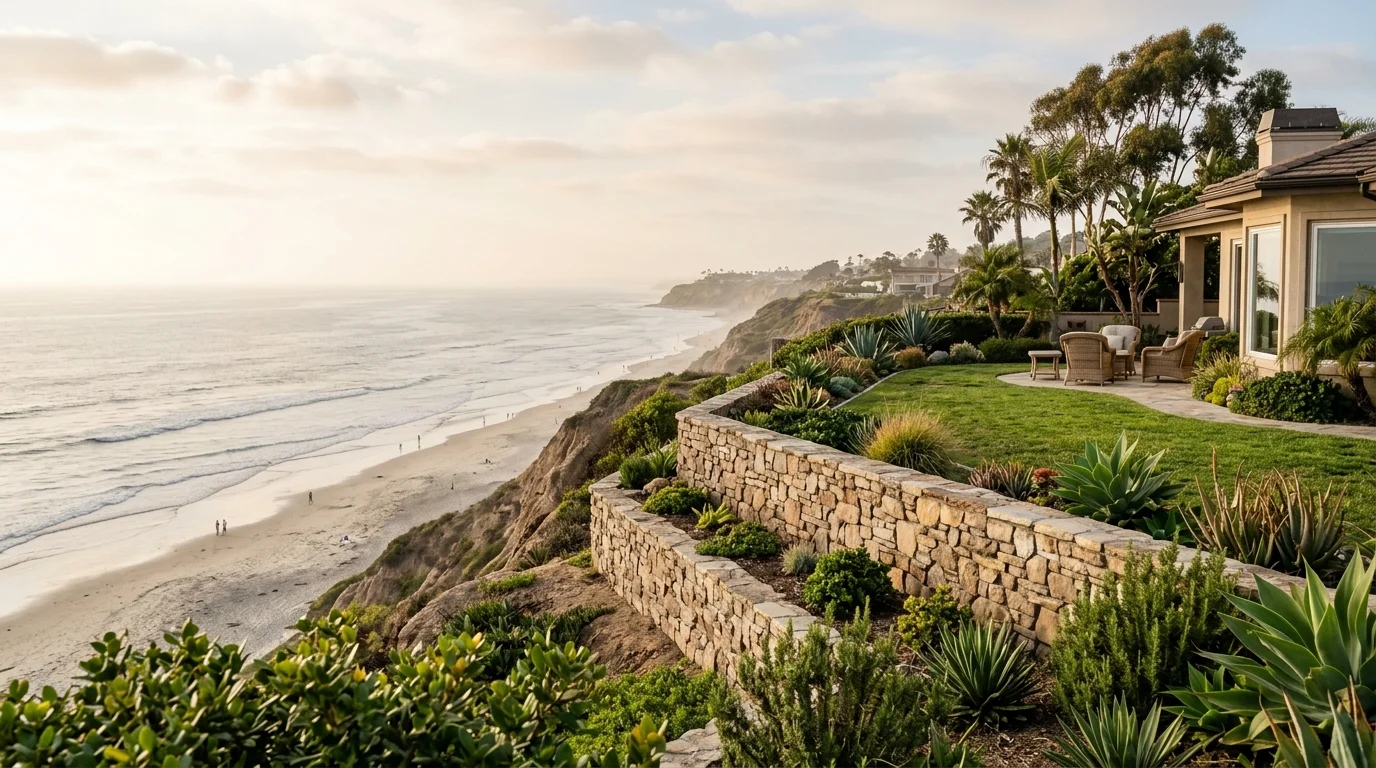
Bluff-adjacent property is a different category of risk
A bluff-adjacent project has two separate questions. One concerns the proposed retaining wall. The other concerns the land supporting the entire project.
Those questions shouldn’t be blended into one sales pitch. A residential wall might retain a landscaped grade or define a yard. It isn’t evidence that the wider bluff has been evaluated. Regional erosion data can’t establish conditions on one Encinitas parcel either.
Start by defining what the wall must do. Record its proposed location, height, and relationship to the property line. Identify every surface above and below it. A driveway, walkway, fence, or structure near the upper grade should be shown to the designer. Drainage also needs a clear destination.
The distance from the bluff matters to the professionals reviewing the site. The exact setback or review rule for an Encinitas property couldn’t be confirmed from the approved primary sources used for this article. Ask the City of Encinitas building department which building, grading, or coastal reviews apply to the parcel. Don’t borrow a threshold from the City of San Diego or unincorporated San Diego County. Those are separate jurisdictions with different retaining-wall rules.
A qualified installer should be comfortable pausing the construction discussion. The site may need an opinion from a licensed design professional first. If the project involves the broader hillside, review slope stabilization services before treating it as an ordinary landscape-wall job.
What the published erosion research says about this coastline
The most relevant federal research is broad, historical, and limited. It doesn’t predict what will happen at a specific Encinitas home.
A USGS coastal cliff study published in 2007 divided California’s coastline into regions. Its Oceanside region extended 86 kilometers from Dana Point to Point La Jolla. That makes it the applicable regional frame for Encinitas, but not a parcel-level report.
Researchers measured 40 kilometers of coastline within that 86-kilometer region. They reported an average cliff retreat of 12 meters and an average rate of 0.2 meters per year. Those figures describe a roughly 70-year historical analysis. They aren’t current erosion rates.
The study also warns that its rates end with the lidar collection date. They may not reflect more recent trends. Coverage represented only part of the region, and local maximums weren’t regional norms. A contractor shouldn’t apply the regional average to one yard, bluff, or wall.
The practical takeaway is narrow. Published research confirms that cliff retreat has been measured across this wider coastal region. It doesn’t tell you whether a proposed wall location is suitable. It also doesn’t establish the needed foundation, setback, drainage plan, or wall type.
That information must come from the parcel and proposed project. Historical regional data can frame the conversation. A site-specific review must answer the design questions.
Inland Encinitas lots and ordinary hillside walls
Not every Encinitas retaining wall is a bluff project. An inland lot may need a wall around a garden, patio, driveway, or sloping yard. The work can still involve meaningful grade, drainage, and boundary decisions.
Begin with the wall’s purpose. A decorative garden edge isn’t the same scope as a wall supporting a driveway. A single wall also differs from several tiers climbing a slope. Give each contractor the same measurements and site information. Otherwise, the proposals won’t describe the same job.
The current Encinitas permit threshold couldn’t be verified from the approved primary sources available for this article. Confirm it directly with the City of Encinitas building department. Ask how wall height is measured and whether backfill, nearby loads, tiering, grading, or location changes the review. If the property isn’t inside city limits, confirm the actual permitting authority before applying any rule.
This distinction matters across San Diego County. The City of San Diego measures one building-permit trigger from the top of the footing to the wall’s highest point. The unincorporated county has a different exemption with several conditions. Neither rule should be presented as Encinitas law.
Once the site and approval path are clear, compare materials. Appearance, engineering, drainage, access, and construction details belong in the same discussion. Homeowners considering a textured finish can review natural stone retaining walls without assuming stone fits every design.
Our Encinitas retaining wall service page explains how Wall Pro SD connects homeowners with licensed, independent local pros. The matched contractor performs the work. Wall Pro SD doesn’t build walls or pull permits.
Why a geotechnical opinion comes first near the bluff
A geotechnical opinion can keep a bluff-adjacent project grounded in site evidence. It should come before choosing a wall system when the wider slope may affect the design.
Ask the reviewing professional to address the proposed wall location and retained material. The review should also consider the slope, nearby improvements, drainage plan, and intended excavation. These questions help separate an isolated landscape wall from a larger land-support problem.
Nearby City of San Diego guidance shows why jurisdiction and site classification matter. Its standard masonry designs can’t be used on sites with listed Coastal Bluff Stability hazards. The same guidance says walls outside its standard criteria must be designed by a California-licensed civil engineer, structural engineer, or architect. A geotechnical investigation may also be required, depending on location.
Those are City of San Diego rules, not Encinitas requirements. They don’t prove that an Encinitas parcel needs the same process. They do show why copying another city’s standard drawing can produce the wrong plan.
The City of San Diego’s hazard maps carry another useful warning. They describe relative regional risk and don’t provide site-specific information. A mapped category shouldn’t be turned into a diagnosis for a neighboring jurisdiction or individual property.
For an Encinitas project, ask the applicable building department what documentation it requires. Then let the appropriate licensed professional define the design basis. The installer can price construction after that scope is clear. This order reduces vague allowances and helps each proposal address the same wall.
Choosing a builder who has worked this ground
Experience should show up in the contractor’s process. Listen for questions about the wall’s purpose, slope, access, drainage, property lines, and nearby loads. A builder who discusses material before the site may be skipping the decisive details.
Ask for examples of comparable work, but verify what you’re shown. Wall Pro SD doesn’t claim another contractor’s projects as its own. A contractor should identify its role and explain whether a licensed engineer, architect, or geotechnical professional participated.
California’s license classifications also deserve careful wording. CSLB’s C-29 description covers masonry work using concrete units, clay products, and natural or manufactured stone. It includes masonry units used for structural load-bearing walls. The C-8 description covers forming, pouring, placing, finishing, and installing concrete work.
CSLB doesn’t publish a universal rule saying every retaining wall requires one particular classification. The appropriate classification depends on the construction and project. Use the CSLB Check A License tool to search by license number, business name, or contractor personnel name.
Compare written scopes, not unsupported price averages. No retaining-wall price per foot could be verified through the approved government sources for this article. Ask each contractor to separate design, permitting support, excavation, wall construction, drainage, backfill, finish work, and cleanup. Confirm who pays outside professionals and government fees.
For a California home improvement contract, state law limits a charged down payment to $1,000 or 10 percent of the contract amount, whichever is less. Apart from that down payment, the contractor can’t request or accept more than the value of work performed or materials delivered. You can read the rule in Business and Professions Code section 7159.5.
A clear proposal should also identify open questions. If the permit path or engineering scope isn’t settled, the contractor shouldn’t disguise that uncertainty with a fixed assumption.
When to call us
Call when an Encinitas wall involves a bluff, hillside, drainage concern, nearby load, or unclear permit path. Call us at (858) 400-4639 and we’ll connect you with a licensed local retaining wall contractor.